


AI Document Processing is revolutionizing the way organizations process documents by automating data extraction, classification, validation, and more ab through complex, document-laden workflows. When you add artificial intelligence to document automation, companies have the ability to cut back on manual processing, mistakes and the time it takes to process.
Intelligent document processing solutions are in high demand for invoice processing, contracts, forms and records in today’s world of advanced IT systems and modern business enterprises. Syncolony’s AI Document Processing platform enables enterprises to automate processing of invoices, contracts, bank statements, and many other business-document types—saving time, reducing errors, and speeding up decision-making across industry sectors.
This article will discuss AI Document Processing , how it functions, its key technologies, applications, and why it has become a strategic capability for data-driven businesses.
What Is AI Document Processing?
Intelligent document processing is the application of artificial intelligence (AI) technologies to the capture, processing, and analysis of business documents. Conventional document processing systems, based on rules and keywords, are not capable of processing unstructured or semi-structured documents with a reasonable accuracy level, unlike AI-based systems.
These tools convert documents such as PDFs, scans, images, and emails into structured, machine-readable data that can be directly fed into business systems.
AI document processing is Frequently used as a substitute term for Intelligent Document Processing (IDP), however, IDP usually highlights more advanced learning, adaptability and continuous improvement.

Why Traditional Document Processing Falls Short
Conventional document processing is highly dependent on:
- Data entry by people
- Static templates and rules
- Human validation at each stage
These methods fail when documents are different in structure, language, or composition. As the number of documents grows, manual procedures are expensive, time-consuming, and prone to mistakes.
AI document processing software breaks these barriers by recognizing patterns, interpreting context and learning new documents without the need for significant rework.
Core Technologies Behind AI Document Processing
- Optical Character Recognition (OCR): OCR processes the scanned documents and images and converts them into text that can be edited. Powered by artificial intelligence (AI), today’s OCR technology offers more than simple text recognition and includes corrections for poor quality scans and handwriting.
- Natural Language Processing (NLP): NLP allows the systems to capture context and semantics in narrative text. It can extract things like names, dates, addresses, totals, and legal clauses.
- Machine Learning (ML): Machine learning algorithms enable intelligent document processing software to learn from past data. As they advance their accuracy on classification, precision on extraction and logic on validation.
- Computer Vision: The computer vision takes document layout, organisation and graphic features into consideration. That’s necessary whenever you work with complex documents like invoices, forms, and bank statements.

How AI Document Processing Works
A typical AI document processing workflow contains the following steps:
- Document Ingestion
Documents can be pushed into the system via email, API, scanners, or cloud storage. - Classification
It recognizes the document type (invoice, contract, receipt, form). - Data Extraction
Important fields are extracted by OCR, NLP and ML models. - Validation & Enrichment
A business rule or an external system validates the extracted data. - Integration & Automation
The structured information is sent to the ERP, CRM, accounting or workflow system.
With this full-cycle automation, enterprises can handle thousands of documents each day with little to no human assistance.
Benefits of Syncolony’s AI-Powered Document Processing
- Increased Efficiency
The processing time is shortened greatly with AI-based document processing by automating monotonous work. - Improved Accuracy
The models reduce human errors and inconsistencies. - Cost Reduction
Operational cost stays low with less manual intervention. - Scalability
Processing of documents with AI-document processing can easily scale for larger document volumes. - Faster Decision-Making
Structured-data in real-time facilitates faster decisions and more timely actions.
AI Document Processing Use Cases Across Industries
Banking and Finance
Financial services organizations rely on automated document workflows to validate KYC documents, bank statements and transactions, and to enable loan and credit scoring faster and with better accuracy.
Insurance
Automation enables claims, policies, and medical or damage assessment forms to be managed more easily, allowing insurers to process more claims with greater accuracy and compliance.
Legal
In legal settings, document automation advances contract analysis, enables structured case file management, and facilitates agreement review by using data intelligence.
Government & Public Sector
With automated processing of tax forms, citizen applications, and regulatory paperwork, public sector entities can operate at scale with increased efficiency and transparency.
Healthcare
Automated workflows facilitate the secure handling of patient records, prescriptions and insurance claims to enable timely access to critical information and support enhanced care coordination.
Retail & E-Commerce
At every step from invoices and purchase orders to returns, refunds, and supplier documentation, automation is making life easier and retail digital.
Manufacturing & Supply Chain
They achieve better control over supply chain processes and mitigate operational bottlenecks through the automation of shipping documents, inventory records and purchase orders.
These examples highlight how automated document workflows have become a vital enabler of efficiency, accuracy, and scalability across modern industries.
AI Document Processing vs Traditional OCR
| feature | Traditional OCR | AI Document Processing |
| Handles unstructured docs | NO | YES |
| Learns from data | NO | YES |
| Context understanding | NO | YES |
| Scalability | Limited | High |
| Automation level | Low | End-to-end |
AI document processing solutions clearly outperform legacy OCR systems in complex, real-world environments.
Security and Compliance Considerations
Processing sensitive documents requires security to be airtight—industries handling financial, legal, or medical information have to be especially vigilant. Enterprise-level AI document processing platforms are made to bear this responsibility.
They employ strong data encryption to protect data at all stages, use role-based access control to limit access to sensitive data to only those who need it, and hold detailed audit logs for transparency and accountability. They are also built to meet stringent regulatory requirements such as GDPR and ISO which are recognized globally.
These safeguards enable organizations to confidently automate document workflows, with no risk of security or compliance.
Modern AI document processing software supports Multi-Language and Format Support
- Multiple languages
- Different Document Formats (PDF, JPG, PNG, DOCX)
- Handwritten and scanned files
This feature is a must for global companies processing documents across their regional and market offices.
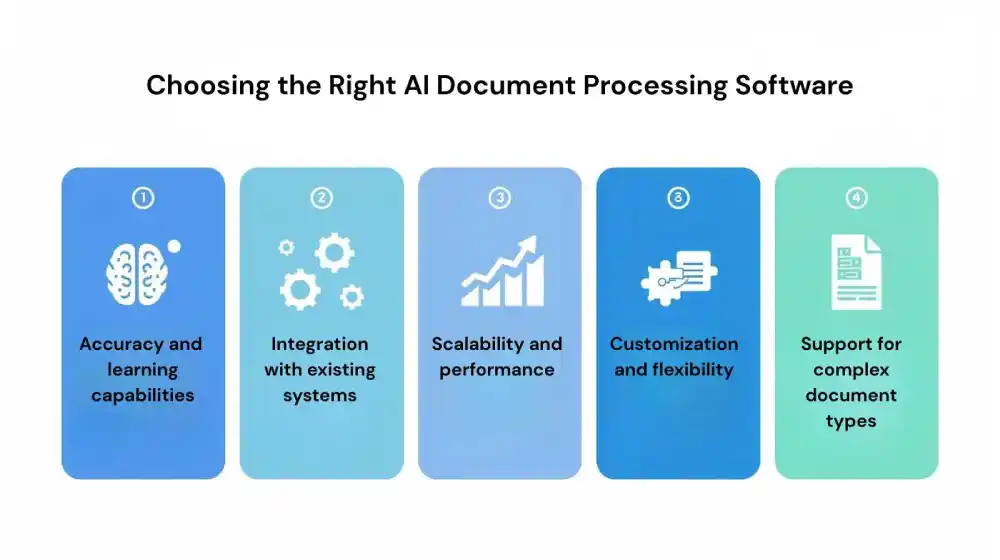
Solutions such as those offered by Syncolony’s Document Processing Software can be tailored to any document type, language or level of difficulty, which makes them best-in-class for document automation at the enterprise scale.
The Future of AI Document Processing
The development of AI-based document processing is undergoing a dramatic change as intelligent technologies are making new breakthroughs. New technologies such as generative AI allow for more profound document understanding, and self-learning extraction models continue to increase in accuracy over time without much human intervention.
Meanwhile, more and more the full, end-to-end process can be automated around documents from intake to decision-making.
In addition to deeper analytics and actionable insights, organizations not only have productive efficiencies but also greater visibility into how they operate.
As companies advance towards all automated, intelligent processes, processing documents with AI will be at the heart of digital transformation — determining how enterprises run, grow, and compete in the years to come.
Conclusion
Processing through AI document is increasingly becoming a basic requirement for any document-intense process today, promising greater efficiency, accuracy, and scalability for those organizations willing to step up. With OCR, NLP, machine learning, and automation, companies are able to convert unstructured documents into actionable information.
Intelligent document processing solutions for businesses allow faster operations, compliance, and smarter decisions across financial services, healthcare, government, and manufacturing.
With the maturation of AI technologies, automation-enabled document workflows will continue to transform enterprise information management at scale.
FAQ
Frequently Asked Questions About AI Document Processing
AI Document Processing is a form of automation that leverages artificial intelligence technology to capture, classify, and validate data in documents such as invoices, contracts and forms. It’s a combination of OCR, NLP, and machine learning that converts unstructured documents into structured data.
OCR simply turns images into text, but AI Document Processing interprets the document context, pulls out certain fields, learns based on data, and completes workflows end-to-end.
Modern AI document processing software supports multiple languages, formats, and document types, including scanned and handwritten documents.
Yes, enterprise AI document processing solutions leverage encryption, access controls, and compliance standards to ensure the security of your sensitive business information.
Contemporary AI DPM software is capable of processing a wide range of languages, formats and document types including scanned documents as well as handwritten ones.
Related Posts
Have Questions?
Contact Us