
Use Cases & Industry Applications of Smart Gates: Transforming Access, Security, and Operational Efficiency
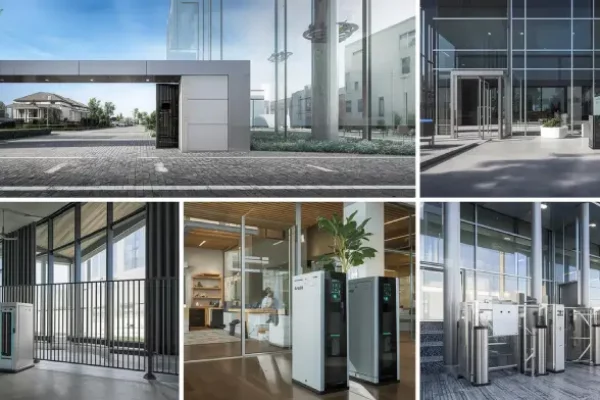
Today’s physical access is much more than turning a key or pulling up a manual barrier in this age of digital transformation. Smart gates — high-tech entry solutions that use IoT connectivity, cloud management, RFID/NFC authentication and built-in security functionalities — are transforming how organizations protect facilities, regulate vehicle and pedestrian traffic, and gather actionable data in real time.
Table of Contents
ToggleFrom a residential community to a manufacturing facility, corporate campus to transportation hub and even major event venues, access control gates combine automation, intelligence and integration in ways that conventional access systems simply are unable to match. This article demonstrates practical use cases and real industry solutions for smart gate technology and how they help build safer, smarter environments across a wide range of applications.
As organizations seek scalable, secure access solutions, they are increasingly adopting cloud-based and IoT-enabled smart gates — solutions that enhance security and operational workflows as well as offer remote management and data visibility.
1. Residential Complexes and Gated Communities
1.1 More Security, Less Monitoring Required
Residential communities and gated neighborhoods have been among the first users of smart gate systems. Here, it’s crucial to know who can come in and out — safely and with ease.
Home smart gates normally use:
• Residents and authorized visitors use RFID cards or fobs
• Mobile app credentials to replace plastic credentials
• Cloud access logs Log every event in real time
Standing in for the static mechanical locks or guard staffed entrances, smart entry gates allow remote authentication of vehicles and people making unauthorized access harder on multiple fronts. And for gated community leaders, this means tangible enhancements to safety, resident satisfaction and cost efficiency.
1.2 Visitor Access & Temporary Permissions
Second strong example of a good residential use case is visitor access control. Traditional platforms are not designed for permits or temporary passes. Temporary RFID tag for guests
At its conclusion, these credentials can be revoked automatically once access has been granted, avoiding any risk of them being used for unauthorized access or making apple controllers farm PVC inputs on the. Many modern systems are integrated with property management software, allows residents to pre authorize visitors or contractors.
1.3 Easy Integration with Home Automation
Smart entry gates are a natural extension of the broader smart home setup. When gate access is integrated via the same IoT platforms it can activate:
• Capture video
• Turn on or off lights inside
• Change the status of an alarm system
This is a comprehensive security that not only define enclosure boundary access but also increases situational awareness of the entire premises.
2. Commercial & Office Building Applications of Smart Gates
2.1 Employee Access & Identity Management
In enterprise applications, smart gates are not limited to a single point of entry, but friendly to multi-door access control systems, the system manages:
• Multi door access
• Department based permissions
• Hierarchical user roles
By integrating smart gates with a company’s HR infrastructure (e.g. Active Directory, employee db) the process of enabling and disabling access for employees as they join / leave the organization can be automated. This hands-off approach helps to close security loopholes and maintain up-to-date systems with little need for manual administration.
2.2 Multi Factor Authentication for Enhanced Safety
Many enterprises have a mobile + RFID or mobile + biometric authentication model in place to achieve high confidence in identity verification. For example:
• Employees tap a badge and use a fingerprint scanner
• Smart phone + proximity sensor unlocks a gate
These layered approaches make the risk of credential spoofing, cloning, or unauthorized duplication substantially lower — all of which are vulnerabilities that are exploited in older systems.
2.3 Parking & Vehicle Flow Efficiency
Large business complexes have to deal with hundreds if not thousands of cars daily. Smart gates can provide:
• License plate recognition (ALPR)
• Pre registered employee vehicle access
• Reserved space validation
This alleviates congestion, increases throughput, and provides analytic insight on utilization for heat map parking distribution and infrastructure planning.
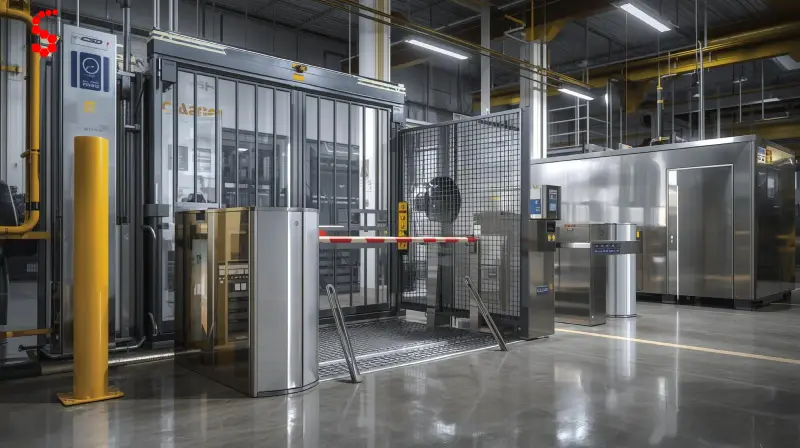
- Smart Gate in Industrial & Manufacturing Facilities
3.1 High Risk Areas - Securing
Industrial locations tend to have more stringent security needs because of high value equipment, off limits areas or hazardous substances. Smart gates assists enforcement of rigid regulations on:
- Access of authorized vehicles
- Shift based access windows allowed
- Areas for material handling
- Contractors and vendors access
Cloud-based analytics allow security personnel to audit access history to sensitive areas, correlate incidents with data from sensors (such as motion or vibration sensors), and fine tune response strategies.
3.2 Operational Systems Integration
In the factory, smart gates are not isolated. They interface with:
- SCADA/industrial controls systems
- Safety interlocks
- Plant scheduling, ERP, etc
This role-based approach guarantees that permissions for access truncation are consistent with production flows and safety considerations – for instance, it stops access to dangerous areas while machinery is in use.
3.3 Automated Vehicle Checkpoints
Gates at the industrial site are designed to handle foot as well as vehicle traffic. Smart gates support:
- RFID vehicle tags
- Automatic boom gate control (uru)
- Truck scheduling and staging
This leads to more efficient and secure supply chains, reductions in carriers idle tow time, and ability to capture entry of shipments and freight in a track able, secure manner.
3.4 Compliance & Audit Tracking
Well, you’re right: Manufacturing companies often do need to comply with regulatory requirements (OSHA, ISO, etc.). Smart gates create immutable logs of who have been in any given zone, when, and using what credentials. This information is useful for audits, incident investigations, and safety certifications.
4. Access Control Gate in Airports, Ports and Transit Centers
4.1 Strong Demand of Security
Transportation hubs are very busy places — straddled by passengers and staff, freight
vehicles and services. Smart gates are key for:
• Secure perimeter control
•Vehicle access control at checkpoints
•Verification of passenger entry and exit.
Both seaports and airports rely on smart gates to enhance security at
security checkpoints, deploy biometric systems, and enable time-based access
limits for employees and service vehicles.
4.2 Proceedings with Customs & Border Security
In customs context, smart gates are combined with sophisticated solutions such as:
•Recognition of container numbers
•ANPR enabled sensors + IoT
•AI assisted verifications
These features are designed to ease lines at border crossings while bolstering border
security measures. Customs officials can also track movements and check for
compliance with end-to-end logging.
4.3 Transit Access Control Multi Modal
Clearance systems can be found at train stations, metro’s, and bus depots etc. These Gates Are Able To:
•Check e tickets using RFID/NFC
•Allow gate access via turnstile
•Use mobile wallets and passes
This not only optimizes passenger flow through stations, but also provides granular analytics of passenger movement.
5. Education Sector Applications of Smart Gates
5.1 Campus Safety and Authorized Access
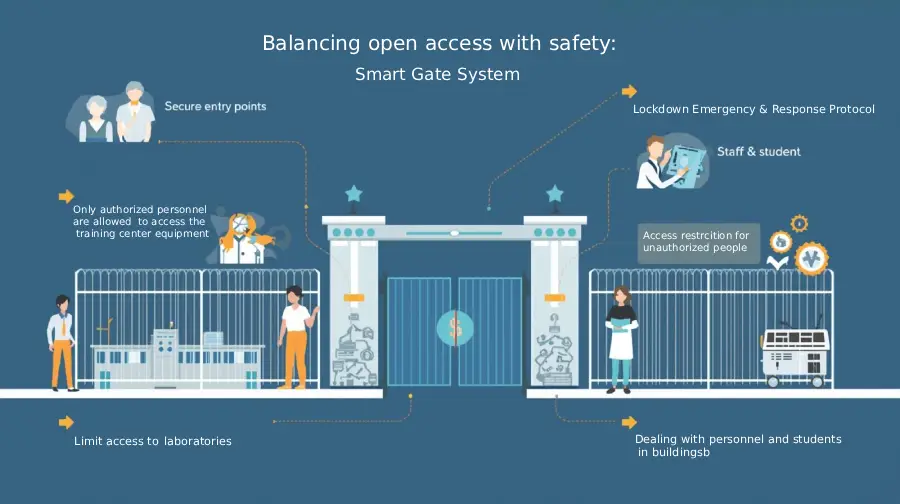
Educational institutions have to straddle the line between openness and security. Smart gates help:
Limit access to laboratories
Dealing with personnel and students in buildings
Control access to dormitories
Credentials can be linked to student IDs, with permissions automatically shifting during academic terms.
5.2 Lockdown Emergency & Response Protocol
During emergencies, smart gates, when configured to do so, go into safe lockdown (all access points are locked with one exception point that is also locked with an option to unlock for emergency exit that is connected with PA systems and emergency response protocols). This leads to a unified and quick reaction in several critical situation.
5.3 Working on Site Visitor & Contract Access
Universities have a plethora of visiting scholars, contractors, and service personnel . Smart gate systems also can create temporary credentials that are automatically revoked after a specific period of time, which enhances security without the need for manual management.
6.Healthcare & Medical Facility Smart Gate Use Cases
6.1 Secure Access for Sensitive Areas
Hospitals and laboratories include high-risk areas such as:
- Operating Rooms
- Pharmacy Storage
- Biohazard Labs
- Storage of Equipment
Smart gates guarantee that only authorized personnel and trusted medical specialists have access to such critical areas with secure credentials and live audit reports.
6.3 Integration with Identity & Health Records
Some are also integrating access control with staff ID systems linked to health records or schedules, so that:
- Expired credentials are automatically revoked
- Temporary Staff are Granted Access Upon Their Appropriate Application Status
It prevents unauthorized access and complies with HIPAA / other regulatory requirements.
7.Smart Gate Applications in Retail, Malls & Parking Areas
The modern retail store and facility: smart gate systems are essential in securing efficiency and operational intelligence in today’s retail and commercial environments. Smart entry gates are increasingly being used in retail establishments, warehouses and other commercial buildings at the storefront, the loading dock, in employee-only entrances and inventory access points. These gates allow a centralized control to regulate the flow of delivery vehicles and deliveries personnel, and have the advantage of be able to restrict access to sensitive areas to only authorized personnel.
Smart gate systems log every access event, which has been shown to greatly reduce hulking and internal theft. When connected to point-of-sale (POS) and inventory systems, access information also allows retailers to see who went into a sensitive area and what they did while there. This enables access control to be a proactive operational tool rather than just a point-in-time security control.
In multi-tenant retail centers like shopping malls and commercial buildings, access control is even more challenging when there are multiple tenants, service providers and a huge number of daily visitors. Smart gate systems allow central access control with a hierarchy of permissions that can be customized according to the different user groups such as tenants, maintenance crew, delivery services. Access to parking can be controlled dynamically, enabling the tenant to administer the reserved spaces and to provide access for visitors for a limited amount of time.
Digital credentials can also be temporarily issued for service technicians or temporary contractors without compromising overall security. This type of control not only increases the safety of an entire facility, but also adds to the best customer experience by eliminating friction at access points and decreasing queues.
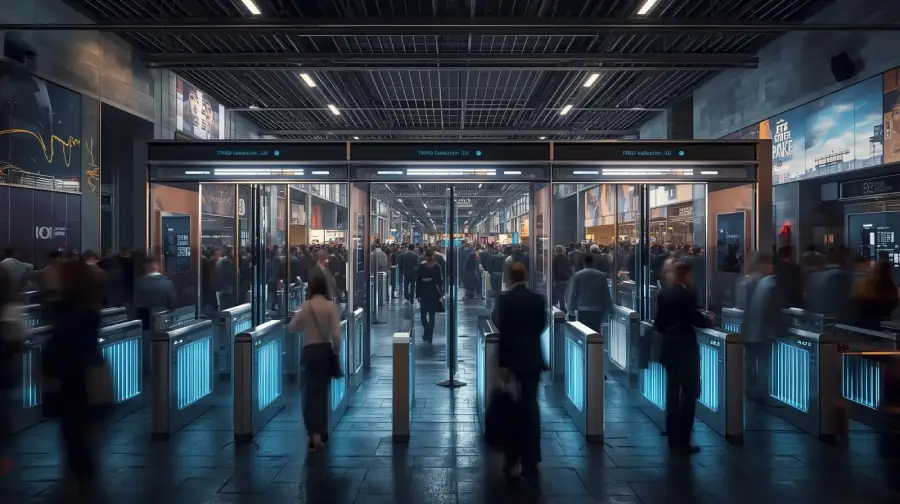
8.Smart Gates in Events and High-traffic Venues
Crowd management of large audiences, for example in concert halls, trade fair grounds, stadiums and large public events, has found large usage in the smart gates. Manual ticket checks are inefficient and there is the potential of human error, which contrasts to smart gate systems that can validate RFID-enabled tickets, digital credentials, and more in just a few milliseconds.
By streamlining entry validation, these systems ease the burden onCSOs, cut down on lines and waiting time and prevent unwelcome guests from gaining access. Real-time occupancy tracking adds another layer of security by enabling event organizers to keep an eye on crowd density and anticipate congestion points.
The technology behind smart gate systems has also evolved with privacy regulations becoming ever more stringent, now supporting privacy-conscious crowd monitoring. Rather than being based just on video surveillance, many advanced systems integrate non-intrusive sensing technologies such as Time-of-Flight (ToF) or infrared people counters. Without taking pictures, these sensors monitor movement and foot traffic, providing great solutions for venues that need to respect data protection regulations and still keep an eye on things. The technique enables them to achieve a good balance of security and safety along with privacy considerations without compromising on performance.
In addition to providing access control and monitoring, smart gates produce valuable data that can be fed into event management and analytics solutions. Organisers are able to make predictions about peaks based on the flow of entries, helping them to make better use of staff and implement queue management policies on a dynamic basis throughout the event. A security system that was once static has the potential to become an information-driven operation asset, enabling venues to better logistics, improve attendee satisfaction, and increase overall efficiency. With the use of smart gate analytics, event directors are provided with actionable insights to assist in the planning and execution of their next event.
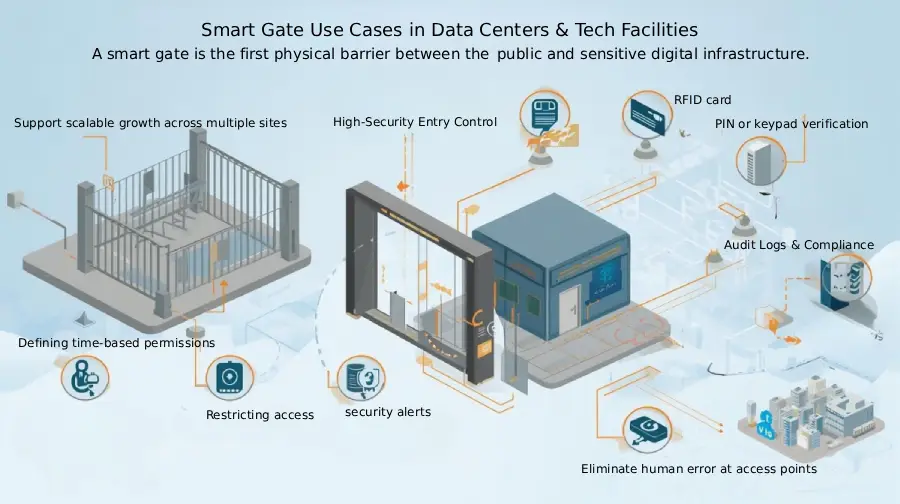
9. Smart Gate Use Cases in Data Centers & Tech Facilities
Data centers and high-tech facilities are among the most security-critical environments in the modern digital economy. These sites host sensitive assets such as servers, networking hardware, proprietary software, customer data, and mission-critical infrastructure. Even a minor breach can result in catastrophic financial loss, regulatory penalties, and reputational damage.
That is exactly the reason why smart gate systems have become the basic component of physical security in data centers and technology spaces. From automated gates to access control gates, cloud management, RFID credentials, biometric verification, and real-time monitoring, smart gates are designed to restrict the access to controlled areas to the right person at the right time for the right reason. Here are the most important use cases of the smart gates making them a must in data centers and high tech environments.
9.1 High-Security Entry Control with Smart Gate Entrance
When it comes to data centers, the physical access controls are just as important as cybersecurity. A smart gate serves as the initial physical obstacle between the public and your sensitive digital infrastructure. And on top of the usual card readers and manual gates, smart gates provide multi-layer, intelligent access that reacts to security rules in this instance. Key features include:
• Access limited to employees, contractors and vendors with permission.
• Defining specific hours-permissions (e.g. Maintenance personnel only during approved windows)
• Locking entrances automatically in the case of a security alert
• Inhibiting tailgating and unauthorized multi-person entry
• Working in conjunction with surveillance and alarm systems
9.2 Smart gate entrances are commonly used at:
• Vehicle perimeters entry
• Pedestrian access areas
• Docks of loading
• Corridors to access server halls
• Sensitive internal areas (Tier III / Tier IV data centers)
By eliminating manual verification and human error, smart gates reduce the possibility of physical security breaches.
Why Smart Gate Access Are a Necessity for Tech Facilities
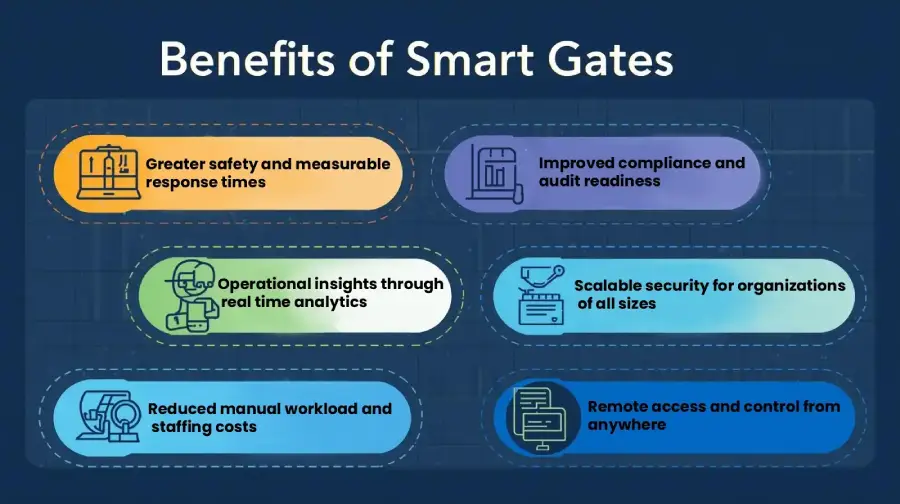
In data centers and high-tech environments, smart gates are more than just a way to control access:
- Reduce burden on security personnel
- Remove opportunity for human error at the point-of-access
- Enforce zero-trust physical security policies
- Scale up for multisite growth
- Bridge physical and digital security postures
- Enhance compliance posture
By extending IoT-enabled access control approach with smart gate entrances, data centers gain enhanced security, operational efficiency, and regulatory assurance.

Conclusion – Smart Gates as a Foundation of Modern Access
The adoption of smart gate technology is no longer a niche trend — it’s a strategic imperative for organizations aiming to safeguard assets, streamline operations, and improve user experience. From residential communities to global enterprises, smart gates deliver automation, security, flexibility, and data in ways that traditional systems simply cannot match.
As access control continues to converge with IoT, AI, and cloud services, smart gates will remain at the forefront of physical security innovation — driving safer, smarter, and more connected environments worldwide.